Lawfare4All Analytical Framework through the Case of Nicolás Maduro


This article revisits the original analytical premises developed by lawfare4all.org, particularly the categories of Lawfare as Ideology and Lawfare as Sabotage, expanding them into a six-dimensional framework for analyzing contemporary political conflict. Rather than treating lawfare as a distortion of legal practice, the article conceptualizes it as an integrated architecture operating across law, communication, institutions, narratives, and coercion. The case involving alleged attempts to kidnap Venezuelan President Nicolás Maduro is examined not as an isolated incident, but as a revealing threshold event, in which all six dimensions converge. The analysis seeks to preserve the critical foundations of the lawfare4all framework while situating it within broader debates on ideology, hybrid warfare, and democratic erosion.

  1. Introduction – Lawfare Beyond Misuse
    The concept of lawfare has often been approached as the instrumental misuse of legal mechanisms for political ends. While descriptively useful, this approach remains analytically insufficient. It reduces lawfare to aberration, exception, or ethical failure, rather than recognizing it as a systemic mode of governance.
    The analytical framework developed by lawfare4all.org departs from this limitation. It treats lawfare not as a deviation from legality, but as a politically productive architecture, capable of reorganizing power relations while maintaining institutional legitimacy. Central to this framework is the refusal to treat law, communication, and coercion as separate domains.
    This article re-centers the original premises of lawfare4all, advancing six interrelated analytical dimensions and applying them to the case surrounding Nicolás Maduro as a critical stress test of the model.
  2. Lawfare as Ideology – The Politics of Denial
    The first foundational premise of the lawfare4all framework is that lawfare operates as ideology, not despite, but because of its claim to neutrality.
    Ideology, in this sense, is not an explicit doctrine. It occupies the space between the public and private spheres, embedding political choices within technical procedures, moral framings, and institutional routines. Every political or economic tendency entails doctrine, whether or not it presents itself as such. The denial of ideology, therefore, is not moderation; it is a characteristic feature of radicalism.
    Lawfare functions ideologically by:
    transforming political disagreement into moral deviance;
    presenting contingent political strategies as legal necessity;
    converting power asymmetries into procedural outcomes.
    In the Venezuelan case, the persistent framing of Maduro as inherently illegitimate precedes and conditions all subsequent measures. Once legitimacy is ideologically withdrawn, extraordinary actions appear administratively reasonable rather than politically extreme.
  3. Lawfare as Sabotage – From Destabilization to Elimination
    The second core premise of lawfare4all defines lawfare as a form of sabotage.
    Traditionally, sabotage refers to deliberate actions aimed at weakening a polity or corporation through disruption or subversion. Within the lawfare framework, sabotage unfolds incrementally:
    economic strangulation through sanctions;
    diplomatic isolation through selective recognition;
    institutional erosion through judicial and media pressure.
    At the personal level, sabotage becomes clandestine and continuous. It may involve reputational destruction, psychological exhaustion, and the erosion of physical security. In extreme cases, it can escalate toward the removal of the political body itself.
    The alleged attempt to kidnap Nicolás Maduro must be read within this continuum. Rather than an anomaly, it represents a logical escalation once sabotage has exhausted its institutional and symbolic phases.
  4. Lawfare as Communication and Silence – Governing Visibility
    A defining feature of the lawfare4all framework is its emphasis on communication and silence as constitutive elements of power.
    Lawfare depends not only on what is said, but on what is rendered unsayable. Information overload, fragmented coverage, and narrative fatigue function as mechanisms of depoliticization. Silence, in this context, is not absence but administrative strategy.
    In the Maduro case, the rapid dissipation of sustained inquiry, combined with the absence of institutional accountability, illustrates how silence stabilizes the effects of sabotage without requiring overt justification.
  5. Lawfare as Architecture of Power – Functional Convergence
    Lawfare does not require centralized conspiracy. It operates through functional convergence among institutions whose mandates remain formally intact.
    Judicial systems, media organizations, financial infrastructures, diplomatic bodies, and security apparatuses act as interfaces within a shared architecture. Each actor performs its role “legally,” while the combined effect produces political coercion without a clear locus of responsibility.
    This architecture allows lawfare to cross jurisdictions, bypass democratic accountability, and normalize exceptional measures as routine governance.
  6. Lawfare as Narrative Production – Making Coercion Thinkable
    Narratives are not epiphenomenal; they are preparatory instruments.
    Through simplification, moral polarization, and personalization of blame, narratives reduce complex political processes to individual obstacles. The leader becomes the problem; removal becomes the solution.
    Within this narrative economy, acts that would otherwise be recognized as violations of sovereignty are reframed as overdue corrections. Narrative plausibility precedes operational feasibility.
  7. Lawfare as Democracy Under Stress – Exception as Rule
    The final dimension of the lawfare4all framework concerns democracy under stress.
    Lawfare does not suspend democratic forms outright. Elections, courts, and media continue to exist. What changes are the criteria of legitimacy, the boundaries of acceptable opposition, and the tolerance for exception.
    When lawfare escalates toward physical coercion, it exposes the fragility of a democratic order that has already normalized exclusion, asymmetry, and silence.
  8. Conclusion – Lawfare as Governance by Other Means
    Revisiting the lawfare4all analytical framework through the case of Nicolás Maduro reveals lawfare not as episodic misuse, but as methodological governance.
    By operating simultaneously as ideology, sabotage, communicational control, institutional architecture, narrative production, and democratic stress, lawfare dissolves the distinction between legality and coercion.
    When lawfare reaches the body, it does not abandon law. It fulfills its latent political function.

Lawfare, comunicação e o custo de falar

Nos sistemas políticos contemporâneos, o lawfare raramente é um fenômeno jurídico isolado. Ele opera em uma arquitetura mais ampla, na qual direito, comunicação e silêncio interagem para moldar relações de poder, delimitar a visibilidade pública e restringir a ação democrática. Compreender essa arquitetura exige ir além da análise jurídica formal e enfrentar as consequências concretas desses mecanismos sobre indivíduos, instituições e a sociedade civil.

É nesse contexto que o lawfare4all.org, em parceria com a Egressos Press, seu publishing arm posiciona-se como parte de um ecossistema independente de pensamento crítico. Ao lado de iniciativas aliadas como o IBEPAC e a Rede Pelicano de Defensores e Defensoras de Direitos Humanos, esse ecossistema se dedica a examinar como o direito e a comunicação vêm sendo cada vez mais mobilizados não para proteger direitos, mas para disciplinar a dissidência e normalizar a exceção.

O lawfare não se sustenta apenas nos tribunais. Ele depende de comunicação estratégica, opacidade administrativa e da produção deliberada do silêncio. Narrativas são fragmentadas, responsabilidades diluídas e a complexidade procedimental é instrumentalizada para esgotar aqueles que desafiam estruturas de poder consolidadas. Nesse ambiente, falar tem um custo — jurídico, profissional, emocional e, muitas vezes, pessoal.

Para defensores e defensoras de direitos humanos, jornalistas, pesquisadores e ativistas, esse custo não é teórico. Ele se manifesta na insegurança jurídica prolongada, em ataques à reputação, na inércia institucional e na lenta erosão das salvaguardas que os sistemas democráticos afirmam sustentar. Quando os mecanismos internos falham ou estão estruturalmente comprometidos, os sistemas internacionais de direitos humanos deixam de ser um privilégio e passam a ser uma necessidade.

É precisamente por essa razão que projetos editoriais como Daunbailofer são relevantes. O livro não trata o lawfare como um conceito abstrato, mas como um método — que se apoia na coordenação entre instrumentos jurídicos e estratégias comunicacionais para produzir conformidade, silêncio ou retirada do espaço público. Ao expor essas dinâmicas, a obra contribui para um esforço mais amplo de reconquista da visibilidade, da responsabilização e do sentido democrático.

O papel de plataformas como o lawfare4all.org não é oferecer conforto, mas clareza. O pensamento crítico raramente nasce em zonas institucionais seguras. Ele costuma ser forjado na interseção entre pesquisa, prática e a experiência da resistência — incluindo a experiência de ser alvo por se recusar a permanecer em silêncio.

Dentro desse marco, a colaboração entre lawfare4all.org, Egressos Press, IBEPAC e a Rede Pelicano representa mais do que um alinhamento editorial. Ela reflete um entendimento comum de que a democracia não depende apenas das leis, mas das condições concretas em que vozes podem ser ouvidas, narrativas podem circular e direitos podem ser defendidos sem medo de retaliação.

Em tempos em que o formalismo jurídico é utilizado para ocultar intenções políticas e a comunicação é gerida para obscurecer responsabilidades, insistir em transparência, investigação crítica e responsabilidade pública torna-se um ato de responsabilidade democrática.

O silêncio, quando imposto, nunca é neutro.
E falar, mesmo quando tem um custo, continua sendo essencial.


Wembley Garcia Campos
IBEPAC

Lawfare, Communication, and the Cost of Speaking Out

Pelicano Network of Human Rights Defenders

In contemporary political systems, lawfare is rarely an isolated legal phenomenon. It operates within a broader architecture in which law, communication, and silence interact to shape power relations, delimit public visibility, and constrain democratic action. Understanding this architecture requires moving beyond formal legal analysis and confronting the lived consequences of these mechanisms on individuals, institutions, and civil society.

This is the context in which lawfare4all.org, in partnership with Egressos Press, its publishing arm, positions itself as part of an independent ecosystem of critical thought. Alongside allied initiatives such as IBEPAC and the Pelicano Network of Human Rights Defenders, this ecosystem is committed to examining how law and communication are increasingly mobilized not to protect rights, but to discipline dissent and normalize exception.

Lawfare is not sustained by courts alone. It depends on strategic communication, administrative opacity, and the deliberate production of silence. Narratives are fragmented, responsibilities diluted, and procedural complexity weaponized to exhaust those who challenge entrenched power structures. In this environment, speaking out carries a cost — legal, professional, emotional, and often personal.

For human rights defenders, journalists, researchers, and advocates, this cost is not theoretical. It is experienced through prolonged legal uncertainty, reputational attacks, institutional inertia, and the slow erosion of safeguards that democratic systems claim to uphold. When domestic remedies fail or are structurally compromised, international human rights mechanisms become not a privilege, but a necessity.

It is precisely because of this reality that editorial projects like Daunbailofer matter. The book does not treat lawfare as an abstract concept, but as a method — one that relies on the coordination of legal instruments and communicational strategies to produce compliance, silence, or withdrawal from the public sphere. By exposing these dynamics, the work contributes to a broader effort to reclaim visibility, accountability, and democratic meaning.

The role of platforms such as lawfare4all.org is not to offer comfort, but clarity. Critical thinking rarely emerges from institutional safe zones. It is often forged at the intersection of research, practice, and the experience of resistance — including the experience of being targeted for refusing to remain silent.

Within this framework, the collaboration between lawfare4all.org, Egressos Press, IBEPAC, and the Pelicano Network represents more than an editorial alignment. It reflects a shared understanding that democracy depends not only on laws, but on the conditions under which voices can be heard, narratives can circulate, and rights can be defended without fear of retaliation.

In times when legal formalism is used to conceal political intent and communication is managed to obscure responsibility, insisting on transparency, critical inquiry, and public accountability becomes an act of democratic responsibility.

Silence, when imposed, is never neutral.
And speaking, even at a cost, remains essential.

Wembley Garcia Campos – IBEPAC

Our Publishing Arm: Egressos Press

The website lawfare4all.org announces an editorial partnership with Egressos Press, which serves as the publishing arm of the lawfare4all ecosystem. Egressos Press is dedicated to the publication of critical works addressing democracy, law, communication, power, and narrative disputes in the twenty-first century.

This collaboration is part of a broader independent ecosystem of critical thought, strengthened by partnerships with the Pelicano Network (Rede Pelicano) and IBEPAC. Together, these initiatives are committed to the defense of human rights, freedom of expression, democratic integrity, and the critical examination of the abusive use of law and communication as instruments of power.

The partnership aims to articulate thought, research, and editorial production around key structural issues shaping contemporary public debate, including:

  • lawfare and the judicialization of politics
  • strategic communication and institutional silence
  • informational asymmetries and narrative control
  • democracy under pressure and normalized states of exception

The first outcome of this collaboration is the integration of the book Daunbailofer into the critical ecosystem of lawfare4all, as a reference work on the role of communication and law in the production of contemporary political conflicts.

More than a promotional initiative, this partnership represents the convergence of platform, publisher, and allied organizations, expanding the circulation of ideas, investigations, and reflections aimed at strengthening informed and critical public debate — even when such efforts challenge institutional comfort zones.

📚 Egressos Press
🌐 lawfare4all.org
🤝 Pelicano Network | IBEPAC

Parceria com Egressos Press

O lawfare4all.org inicia uma parceria editorial com a Egressos Press, editora dedicada à publicação de obras críticas sobre democracia, comunicação, direito, poder e disputas narrativas no século XXI.

A colaboração tem como objetivo articular pensamento, pesquisa e produção editorial em torno de temas estruturantes do debate público contemporâneo, como:

  • lawfare e judicialização da política
  • comunicação estratégica e silêncio institucional
  • assimetrias informacionais e controle narrativo
  • democracia sob pressão e regimes de exceção normalizados

O primeiro resultado dessa parceria é a integração do livro Daunbailofer ao ecossistema crítico do lawfare4all, como obra de referência sobre o papel da comunicação e do direito na produção de conflitos políticos contemporâneos.

Mais do que uma iniciativa de divulgação, trata-se da convergência entre plataforma e editora, ampliando a circulação de ideias, investigações e reflexões voltadas ao fortalecimento do debate público qualificado.

📚 Egressos Press
🌐 lawfare4all.org

IBEPAC recebe distinção do Conselho Nacional de Justiça

Depois de anos de atuação incansável, o Instituto Brasileiro de Estudos e Pesquisas de Compliance (IBEPAC) alcançou um marco histórico: foi oficialmente reconhecido pelo Conselho Nacional de Justiça (CNJ) como uma instituição cidadã em defesa da moralidade administrativa. A decisão, registrada nos autos da Consulta n.º 0001856-52.2025.2.00.0000, legitima o papel do Instituto como voz ativa da sociedade civil no controle social da Administração Pública.

O CNJ destacou que o estatuto social do IBEPAC contempla expressamente a defesa do concurso público para delegações de serventias extrajudiciais, o combate à má gestão de recursos públicos e a fiscalização da moralidade administrativa. Essa afirmação reforça a seriedade, a consistência e a relevância do trabalho que o Instituto desenvolve ao longo de sua trajetória.

A importância dessa conquista foi ainda ressaltada pelo Ministro Luís Roberto Barroso, no Mandado de Segurança n.º 37.228, ao reconhecer o valor da atuação institucional do IBEPAC na promoção da transparência e no enfrentamento de irregularidades no exercício interino de serventias. Trata-se de um reconhecimento jurídico e institucional da legitimidade do IBEPAC para provocar o CNJ em questões cruciais para o futuro do serviço público no Brasil.

Essa vitória não é apenas do IBEPAC. Como integrante da Rede Pelicano de Direitos Humanos e do projeto Lawfare4All, o Instituto fortalece todo um movimento que denuncia o uso distorcido do sistema de justiça como instrumento de perseguição (lawfare) e que promove a ética, a transparência e a defesa dos direitos fundamentais.

Hoje, celebramos mais do que uma decisão favorável: celebramos o fortalecimento da sociedade civil organizada na proteção da democracia e no combate aos abusos de poder. O reconhecimento do CNJ mostra que a mobilização cidadã é capaz de abrir caminhos para um país mais justo, íntegro e comprometido com o bem comum.

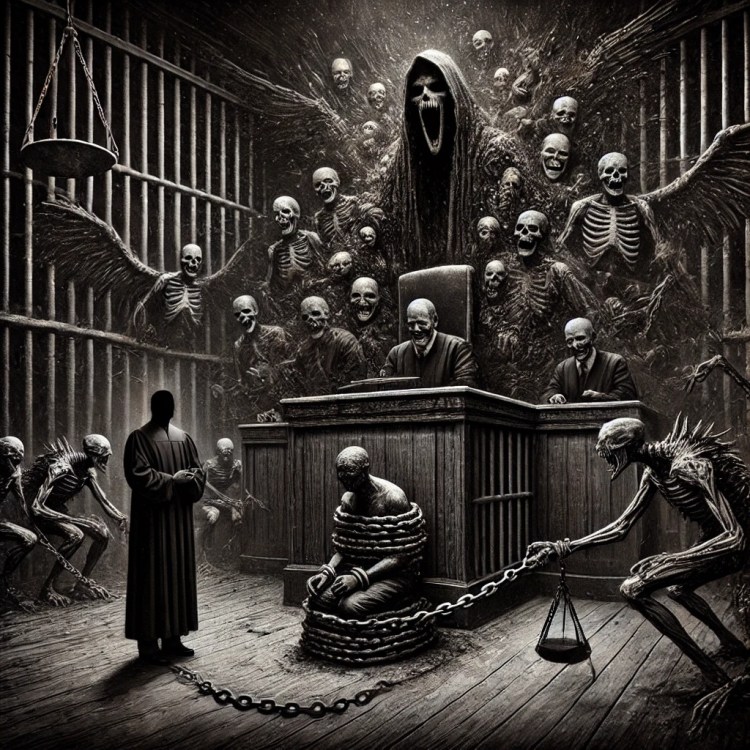
LAWFARE HORROR SHOW GOES ON!

CHECKMATE

Where the hell did the much-vaunted defense of the Brazilian Democratic Rule of Law go?

BETWEEN THE DEVIL AND THE DEEP BLUE SEA

Find out about the allegations of human rights violations presented by Juliana Gomes Antonangelo and the Brazilian Institute of Political, Administrative, and Constitutional Studies (IBEPAC) before the Inter-American Commission on Human Rights (IACHR) that put the Brazilian State in checkmate.
PART I: CANNON SHOT TO KILL A BIRD
How a human rights defender became a target of Lawfare
PART II: MACHIAVELISM 7 X 1 POSITIVISM
How the Brazilian state is turning Lawfare into a flag
PART III: CONVICTION WITHOUT SENTENCE
How human rights violations happen in this case
PART IV: AI Opinion
How artificial intelligence analyzes Brazilian Justice denialism

特朗普对巴西的高额关税攻击

一场全方位的“法律战”行动

特朗普对巴西出口产品实施的50%关税,不仅仅是一项经济措施。它是一场象征性与法律上的战争行动,动员了修辞、外交压力、失真信息、战略勒索与意识形态迫害。

通过 Lawfare4All.org 提出的六个维度分析,这一关税攻击清楚地展示了法律、外交与贸易如何被武器化,成为高影响力的政治工具。


⚖️ 一、“法律战”作为迫害(Persecution)

这项关税可被解读为一种披着贸易政策外衣的经济迫害。此举在针对特朗普在巴西政治盟友的司法判决之后不久发布,却以捍卫美国民主为由——没有证据,也没有双边条约依据。这是一种针对现任巴西政府及其意识形态路线的惩罚性行动,可能给整个社会多个行业带来经济苦难。

贸易制裁正被当作武器,对民主选举政府发动法律与外交恐吓。


🧠 二、“法律战”作为失真信息(Disinformation)

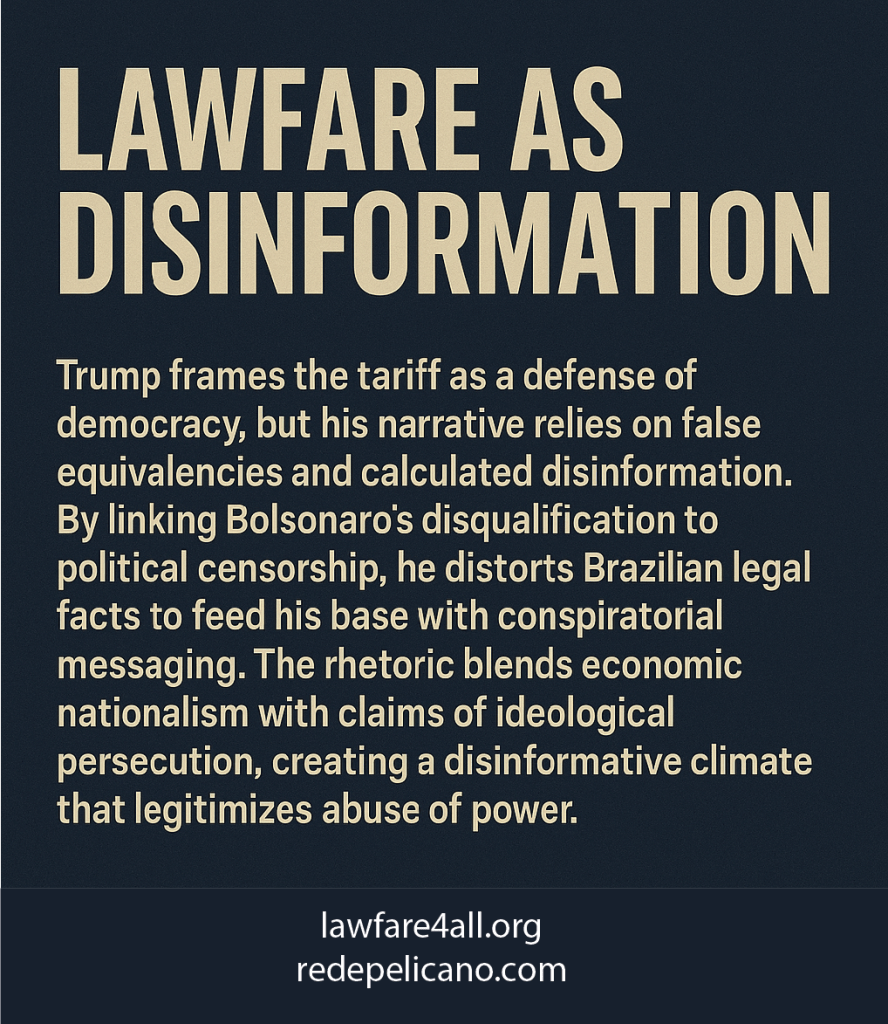
特朗普将此关税包装为“民主防御”,但其话语却建立在虚假类比与有意误导之上。他将博尔索纳罗被“取消资格”与“政治审查”挂钩,歪曲巴西的司法事实,向其支持者灌输阴谋论。这种修辞将经济民族主义与意识形态迫害论结合,营造出一种合法滥权的失真环境。

一场政治操作被伪装成道德防御,带来的是混乱、分裂与极端化。


🎮 三、“法律战”作为博弈论(Game Theory)

这项关税可视为一种非合作博弈中的策略手段,特朗普以经济威胁作为谈判筹码。其目的包括:

  • 削弱全球南方的进步政府;
  • 确保未来贸易谈判中的主导地位;
  • 通过经济胁迫强制地缘政治站队。

同时,这也是向国内外盟友展示单边行动意愿的一种信号。此举助长了外交勒索与有意制造的不稳定

这就是以经济保护为名的恐吓式法律战。


💰 四、“法律战”作为新自由主义(Neoliberalism)

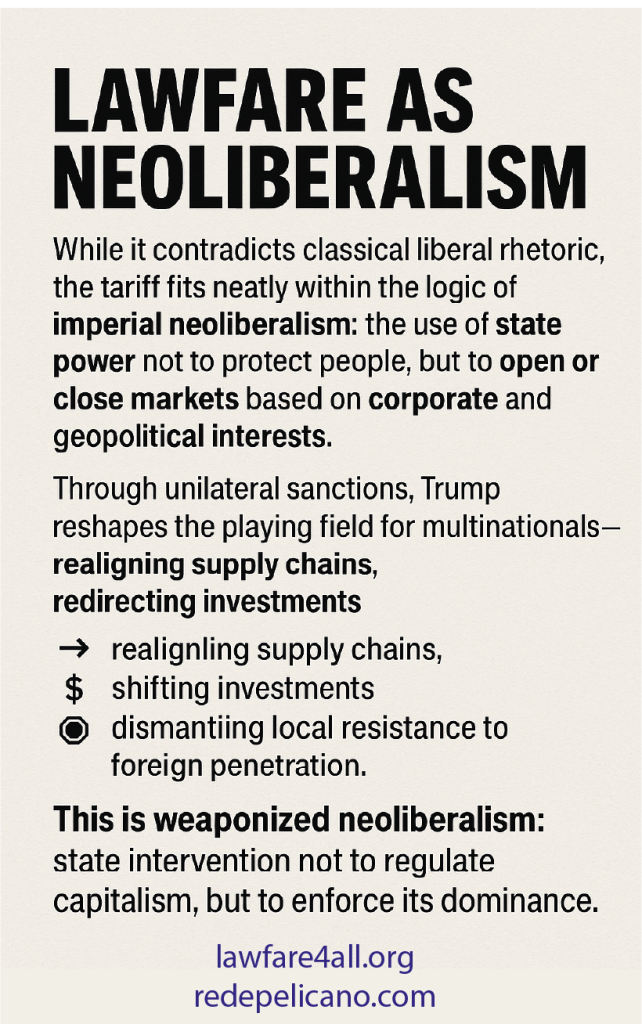
尽管与经典自由主义言论相悖,但此关税恰恰符合帝国新自由主义逻辑:国家权力被用来重新配置市场,而非保护民众。通过单方面制裁,特朗普扭转跨国企业竞争格局,迫使供应链重组、资本转移,并削弱本地抵抗外国介入的能力。

这是一种武器化的新自由主义:国家干预,只为巩固霸权。


🧱 五、“法律战”作为意识形态(Ideology)

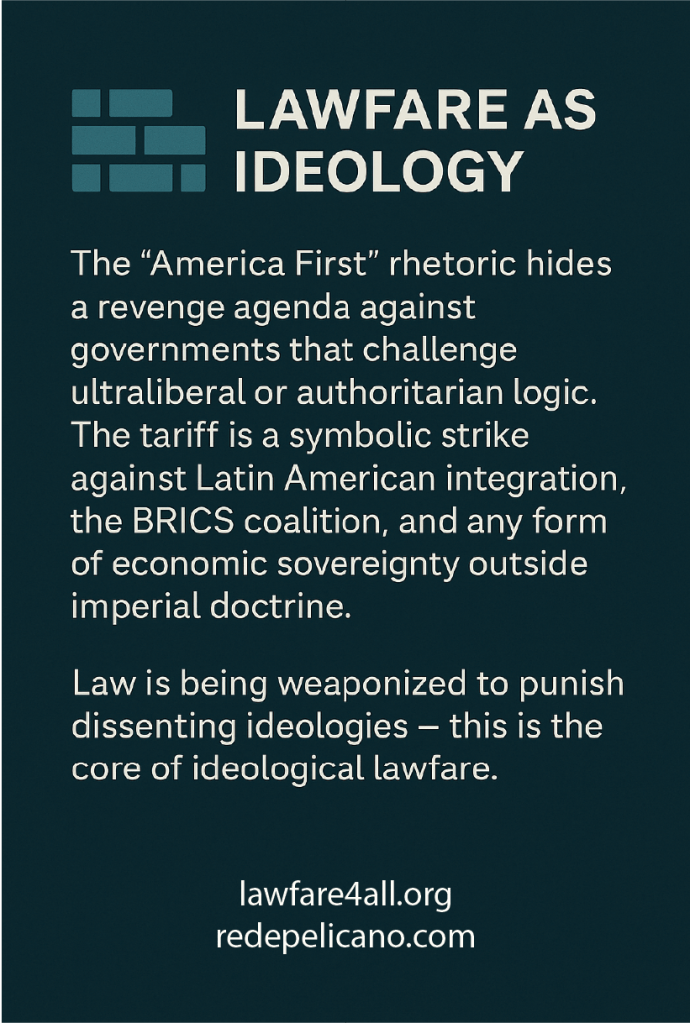
此举体现了一种被“经济中立”掩盖的意识形态工程。“美国优先”的口号掩饰了针对挑战其垄断逻辑的政府的报复计划。该关税是对拉美一体化、金砖国家以及任何非帝国主义经济主权形式的象征性打击

这里,法律被用来惩罚意识形态异己——这正是意识形态法律战的核心。


💣 六、“法律战”作为破坏(Sabotage)

从战略角度看,这项关税也是一种破坏行动,旨在多层面削弱巴西:

  • 阻断对外贸易;
  • 引发货币波动;
  • 分裂巴西公众舆论;
  • 削弱国际合作伙伴的信心。

这不仅仅是一场出口限制行动,而是对巴西政治稳定和全球声誉的致命打击。这种破坏行径隐秘,却通过看似“合法”的法律机制运作。

法律战在此是穿着外交外衣的静默破坏。

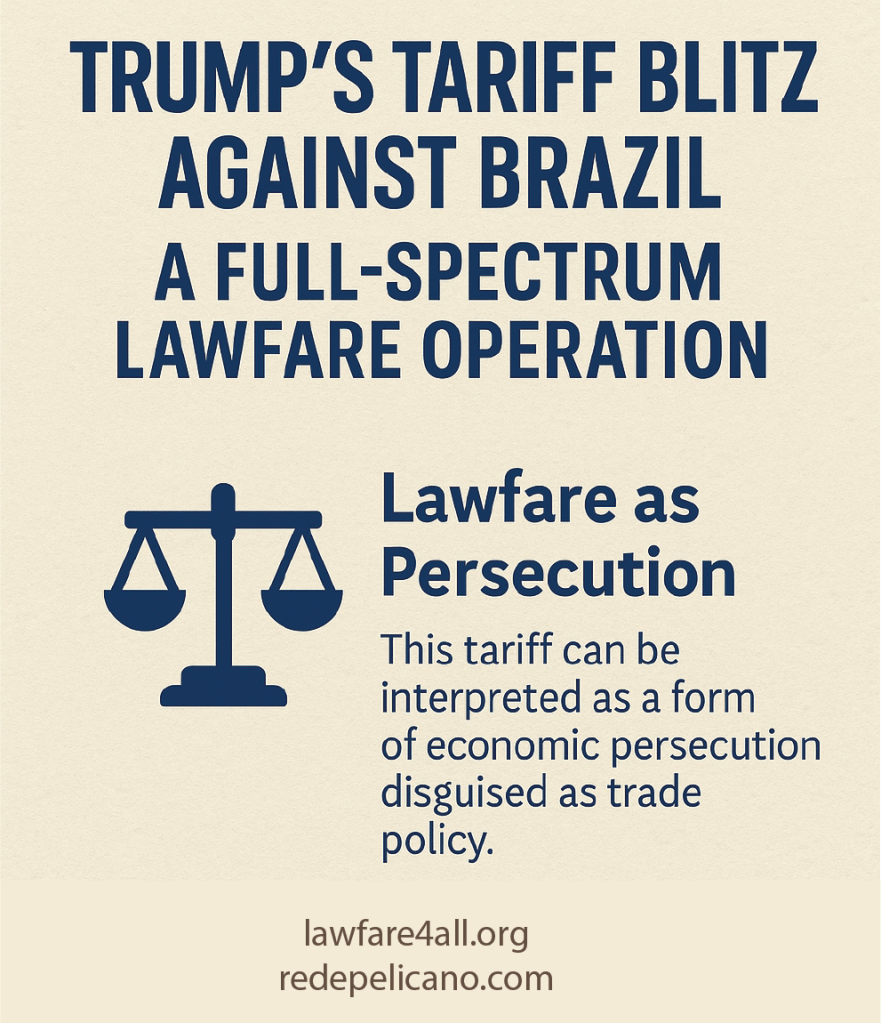
TRUMP’S TARIFF BLITZ AGAINST BRAZIL

A FULL-SPECTRUM LAWFARE OPERATION

The 50% tariff imposed by Trump on Brazilian exports is not just an economic measure. It is an act of symbolic and legal warfare that mobilizes rhetoric, diplomatic pressure, disinformation, strategic blackmail, and ideological persecution.

When analyzed through the six dimensions proposed by Lawfare4All.org, this tariff attack is a crystal-clear example of how law, diplomacy, and trade can be weaponized into high-impact political tools.


⚖️ 1. Lawfare as Persecution

This tariff can be interpreted as a form of economic persecution disguised as trade policy. The measure was announced shortly after judicial decisions against Trump’s political allies in Brazil and was justified by alleged threats to U.S. democracy—without evidence or basis in bilateral treaties. It is a punitive act aimed at the current Brazilian government and its ideological alignment, with the potential to cause economic suffering across entire sectors of society.

Trade sanctions are being used as a weapon against a democratically elected government, creating an environment of legal and diplomatic intimidation.


🧠 2. Lawfare as Disinformation

Trump frames the tariff as a defense of democracy, but his narrative relies on false equivalencies and calculated disinformation. By linking Bolsonaro’s disqualification to political censorship, he distorts Brazilian legal facts to feed his base with conspiratorial messaging. The rhetoric blends economic nationalism with claims of ideological persecution, creating a disinformative climate that legitimizes abuse of power.

A political maneuver is disguised as moral defense. The result: confusion, division, and polarization.


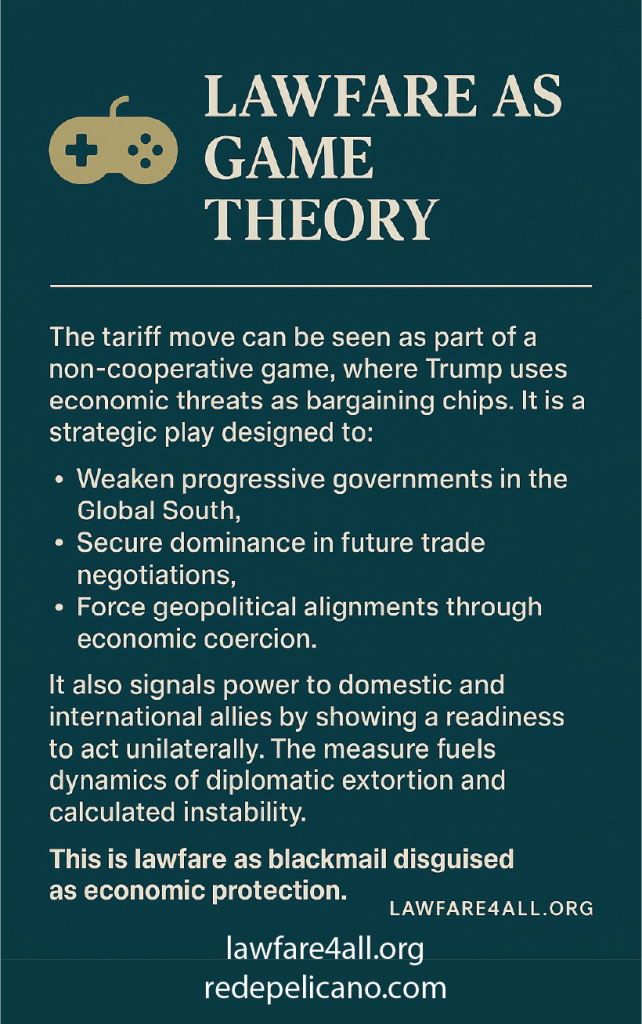
🎮 3. Lawfare as Game Theory

The tariff move can be seen as part of a non-cooperative game, where Trump uses economic threats as bargaining chips. It is a strategic play designed to:

  • Weaken progressive governments in the Global South,
  • Secure dominance in future trade negotiations,
  • Force geopolitical alignments through economic coercion.

It also signals power to domestic and international allies by showing a readiness to act unilaterally. The measure fuels dynamics of diplomatic extortion and calculated instability.

This is lawfare as blackmail disguised as economic protection.


💰 4. Lawfare as Neoliberalism

While contradicting classical liberal rhetoric, the tariff aligns perfectly with imperial neoliberal logic: using state power not to protect people, but to open or close markets according to corporate and geopolitical interests. By imposing unilateral sanctions, Trump reshapes the field for multinationals, forcing supply chain realignments, shifting investments, and dismantling local resistance to foreign penetration.

This is weaponized neoliberalism: the state intervenes, but only to reinforce hegemony.


🧱 5. Lawfare as Ideology

This measure reflects an ideological project masked as economic neutrality. The “America First” rhetoric hides a revenge agenda against governments that challenge ultraliberal or authoritarian logic. The tariff is a symbolic strike against Latin American integration, the BRICS coalition, and any form of economic sovereignty outside imperial doctrine.

Law is being weaponized to punish dissenting ideologies—this is the core of ideological lawfare.


💣 6. Lawfare as Sabotage

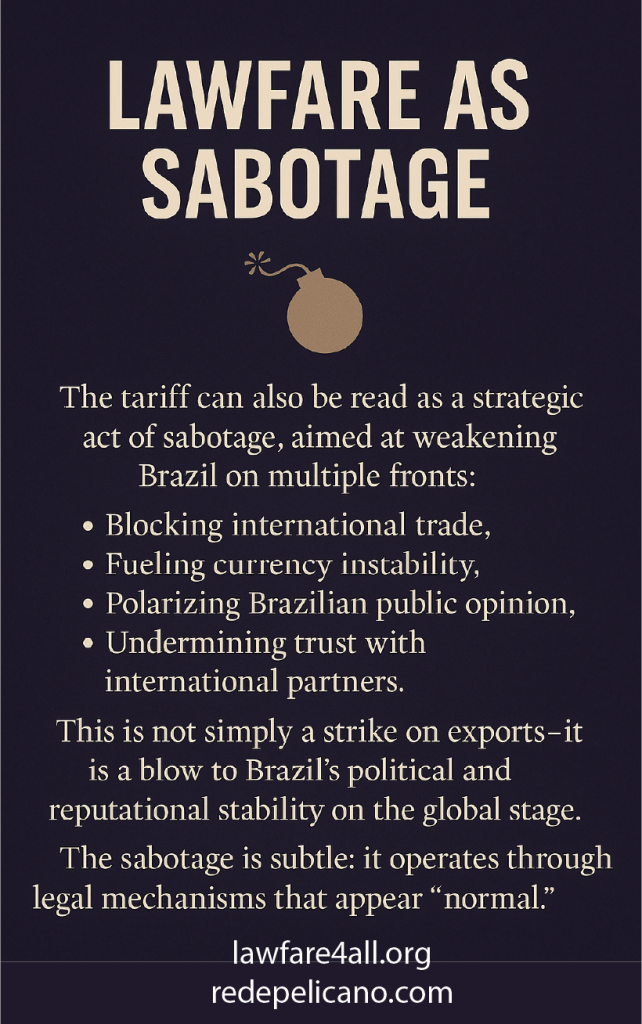
The tariff can also be read as a strategic act of sabotage, aimed at weakening Brazil on multiple fronts:

  • Blocking international trade,
  • Fueling currency instability,
  • Polarizing Brazilian public opinion,
  • Undermining trust with international partners.

This is not simply a strike on exports—it is a blow to Brazil’s political and reputational stability on the global stage. The sabotage is subtle: it operates through legal mechanisms that appear “normal.”

Here, lawfare is silent sabotage disguised as diplomacy.