Freedom of the Press | Journalism | Rule of Law | Lawfare
With all due respect, Justices: who can the State recognize as a journalist?
If the Supreme Federal Court decided in 2009 that the State cannot require a degree or create a state council to oversee journalism, how far can it now interfere in defining who is a journalist without compromising the very freedoms it aims to protect?
Lawfare4All · Editorial · August 21, 2026 · 14 min
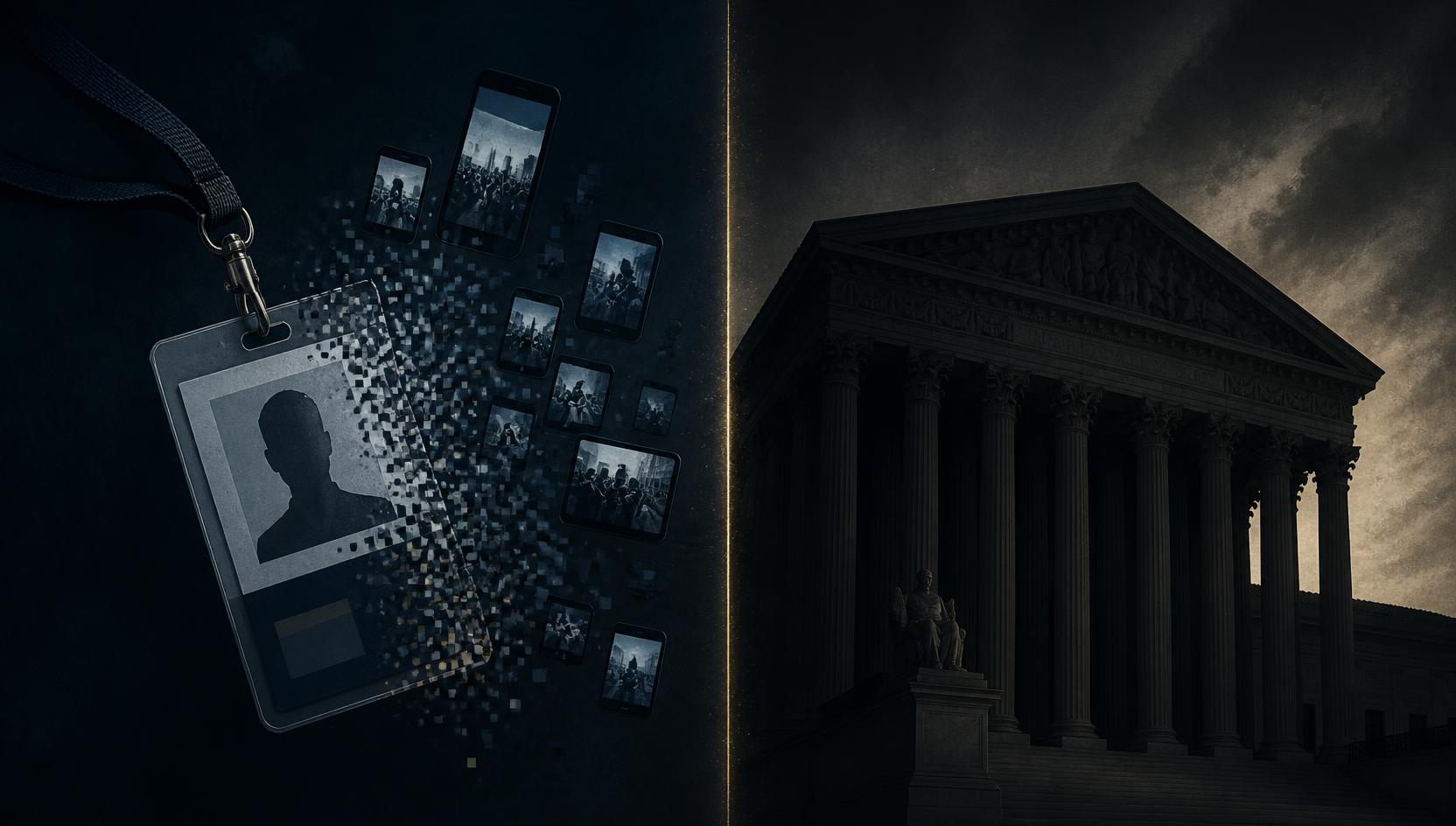
If the Supreme Federal Court decided, in 2009, that the State cannot turn a specific degree into a condition for the practice of journalism, nor create a professional order or state council to oversee it, how far can it now interfere in defining who is a journalist without compromising the very freedoms it aims to protect?
This seems to be the central question behind the debate that returned to the Supreme Federal Court in August 2026. The discussion is not just about the mandatory journalism degree, nor is it limited to source confidentiality in the case involving Maranhão journalist Luís Pablo Conceição Almeida. The problem is broader: who can the State recognize as a journalist, what criteria can it use to do so, and how much power can it accumulate to credential, oversee, or sanction those who carry out an activity directly linked to the freedoms of expression and information?
The issue gained new relevance after Justices Flávio Dino and Alexandre de Moraes advocated for resuming the discussion on specific training for the professional practice of journalism, in a context marked by social media, digital platforms, and large-scale disinformation. The world has changed profoundly since 2009, and that is indisputable. The challenge lies in knowing whether these transformations constitutionally justify re-establishing control mechanisms over journalism that the Supreme Court itself considered incompatible with fundamental freedoms.
The 2009 precedent said more than "no degree"
On June 17, 2009, by a vote of eight to one, the STF struck down the requirement of a specific Journalism degree as a condition for practicing the profession. In Extraordinary Appeal 511.961, with Justice Gilmar Mendes as rapporteur, the prevailing understanding was that the requirement set forth in Decree-Law 972/1969 had not been received by the 1988 Constitution.
The decision was not limited to considering a rule enacted during the military regime as outdated. The grounds were constitutional. The Supreme Court directly linked state control over access to journalism to the freedoms of expression, information, and communication protected by Articles 5 and 220 of the Constitution.
And it went further. The jurisprudence recorded by the STF itself states that the impossibility of state controls over the journalistic profession also leads to the conclusion that the State cannot create a professional order or council, in the form of an autarchy, intended to oversee the profession. According to the precedent, the exercise of the State's police power is forbidden in this field precisely because the freedoms of expression and information predominate.
This significantly broadens the scope of the current debate. We are not just asking whether a new ordinary law could once again require a degree. We are asking how far the state's power to define, credential, and oversee those who practice journalism can extend.
Yes, the information system has completely changed
It would be a mistake to frame the current discussion as if 2026 were merely a repeat of 2009. It is not. The information environment has been radically transformed by social media, smartphones, digital platforms, algorithms, influencers, independent channels, instant messaging, and, more recently, generative artificial intelligence.
Today, anyone can publish to thousands or millions of users without relying on a newsroom, broadcaster, printing press, or public concession. Authorities communicate directly with their followers, independent journalists build their own audiences, influencers compete for informational space with traditional media outlets, coordinated networks can produce and distribute false content, and artificial intelligence systems create synthetic texts, images, voices, and videos at an unprecedented scale and speed.
Therefore, the answer to the question "what has changed since 2009?" is simple: practically the entire ecosystem of information production, distribution, and consumption has changed. But acknowledging this transformation does not end the constitutional debate. On the contrary, it makes the question more demanding: do these changes make it constitutionally legitimate to re-establish state control mechanisms over an activity that the STF directly linked to the freedoms of expression and information? And, further, would the proposed mechanism actually solve the problem it purports to address?
A degree is not a vaccine against disinformation
Higher education courses in Journalism have evident value. They can offer technical training, reporting methods, ethical reflection, legal knowledge, press history, cultural repertoire, narrative techniques, and an understanding of the democratic role of communication. Recognizing all this does not require turning a degree into a state license to inform.
A university credential certifies academic training. It does not certify truth, does not guarantee independence, does not prevent manipulation, and does not automatically turn anyone into an excellent journalist, much less a Pulitzer Prize winner. Journalists with degrees can make mistakes, act unethically, or produce false information. Journalistic enterprises can make serious errors. People without specific training, in turn, can produce investigations of enormous public interest and high-quality journalism.
The existence of a degree does not prove that certain information is true, just as its absence does not prove it is false. Therefore, if the fight against disinformation is used as an argument to re-establish the requirement, there is a causal problem that needs to be demonstrated.
Much of contemporary disinformation is not produced by people who intend to practice journalism professionally. It can come from political campaigns, governments, companies, influencers, organizations, anonymous users, coordinated networks, or automated systems. Requiring journalists to have a degree would not prevent these structures from continuing to produce and distribute false content.
Combating disinformation requires media literacy, transparency, accountability, pluralism, strengthening professional journalism, correction mechanisms, access to information, and subsequent liability in cases provided by law. A degree is training. It is not an antidote to lies.
The Luís Pablo case exposed the boundary
The investigations involving Luís Pablo and individuals identified as his sources have made this discussion even more sensitive. The constitutional protection of source confidentiality does not make journalists or sources immune to criminal investigation. A source can commit a crime, just as a journalist can. If there is independent evidence of illicit practices, the investigation can proceed within the applicable constitutional and procedural guarantees.
The problem arises in defining where the investigation of a possible criminal conduct ends and where the investigation of the journalistic activity itself begins. Commenting on the episode, Gilmar Mendes acknowledged the protection of sources as a central element of press freedom but stated that it is necessary to examine the concrete circumstances, including the possibility of the journalistic activity being used for other purposes.
This formulation does not authorize the conclusion that there was an intention to professionally disqualify Luís Pablo. But it does expose an important constitutional question: if the STF itself decided that the State cannot condition the practice of journalism on holding a specific degree, then the absence of that credential cannot, by itself, answer the question of who is engaged in journalistic activity for the purposes of constitutional protection. The Constitution does not protect a degree, but freedoms and democratic functions.
The paradox of the credential
Imagine the following situation: the State affirms that a certain credential cannot be a mandatory requirement for someone to practice journalism. Later, in a controversy involving source confidentiality, freedom of the press, or prerogatives related to journalistic activity, this same credential begins to influence the definition of who deserves protection.
If a degree cannot function as a mandatory gateway to journalism, its absence should not automatically function as an exit from the guarantees related to the legitimate exercise of this activity.
Extraordinary Appeal 511.961 did not define the legal criteria for the application of source confidentiality, and this distinction must be maintained. But any attempt to use the absence of a degree as a determining factor to reduce constitutional protection would have to be reconciled with a precedent that rejected precisely this credential as a condition for access to journalism.
This also does not mean that anyone can simply self-declare as a journalist to acquire criminal immunity. Not every post is journalism, not every influencer practices journalism, and not every blogger engages in journalistic activity just because they publish content. It is precisely for this reason that the discussion requires better criteria than a purely documentary answer.
The concrete activity can provide relevant elements: the existence of investigation, the pursuit of information of public interest, relationships with sources, verification, production of informative content, publication, and subsequent accountability. The constitutionally important question ceases to be just "what degree does this person have?" and comes to include another: what was this person effectively doing?
Investigating a crime is not investigating journalism
This distinction must remain clear. Investigating someone who is also a journalistic source does not necessarily mean violating source confidentiality. A different situation occurs if someone is investigated precisely because of their status as a source and the objective of the investigation is to identify the origin of information obtained in the legitimate exercise of journalistic activity.
The scenarios are not equivalent. Each case depends on the facts, the existing evidence, the purpose of the measures taken, and their justification.
In the Luís Pablo episode, a Federal Police report released by the press stated that it was not possible to conclude that the journalist had received R$ 100,000 to produce reports against Minister Flávio Dino. The Federal Police indicated the need for further investigation. This does not close the investigation, does not represent a premature acquittal, and does not constitute proof of guilt. An absence of conclusion is an absence of conclusion, and this caution should apply to all involved.
André Mendonça and investigating without targeting the journalist
An episode that occurred this Friday, August 21, 2026, offers an important counterpoint within the Supreme Court itself. When ordering the expansion of the investigation into possible leaks of classified information related to the INSS fraud case, Justice André Mendonça directed that the inquiry focus on the authorities responsible for preserving that data, without affecting journalists, reaffirming the constitutional protection of source confidentiality.
The cases are different. There is no basis to assume an identity of facts, evidence, or legal circumstances, much less to conclude that a procedural solution adopted in one inquiry must necessarily be reproduced in another.
It is not necessary to choose between investigation and freedom of the press. It is necessary to delimit one without destroying the other.
The relevance lies in the method. The episode shows that it is possible to investigate a potential illicit act related to the origin of a leak without automatically turning the journalist, their professional activity, or their relationship with the source into the object of the investigation.
And who will decide who is a journalist?
Here, the discussion about a possible professional council connects directly to the central problem. If a degree alone does not resolve who practices journalism, could a professional order or council fulfill this function?
The 2009 precedent itself presents a significant constitutional obstacle to this solution. The STF recorded that the State could not create a professional order or council, as an autarchy, to oversee journalism, because this would entail the exercise of state police power precisely over an activity linked to the freedoms of expression and information.
This point deserves attention because the idea of some structure for professional recognition has reappeared in public debate. The discussion about self-regulation or private and voluntary forms of professional organization, however, is different from the creation of an autarchy endowed with state power. Professional associations, codes of ethics, self-regulation mechanisms, and civil society organizations can create standards, promote qualification, and ensure reputational accountability. It is another thing entirely to grant a state entity the power to credential, oversee, suspend, or exclude professionals from an activity so intimately related to the freedom to inform.
The question, therefore, is not merely a corporate one. If the State cannot decide in advance who is authorized to practice journalism, how could it create a structure endowed with state power to oversee those who do? And, in a democracy, who would oversee the overseer of the freedom to inform?
The problem of social networks doesn't make the answer simpler
It is precisely the new digital environment that makes it difficult to define the contemporary journalist. In the 20th century, social identification was easier: newsrooms, print newspapers, radio stations, magazines, television broadcasters, communication companies, and recognizable professional ties.
Today, there are journalists in large media outlets, independent professionals, newsletters, podcasts, digital channels, specialized blogs, and journalistic organizations that do not even have traditional newsrooms. There are also people who adopt journalistic language and appearance for activities of a completely different nature.
This problem is real, but its complexity does not make a simplistic solution constitutionally adequate. A degree demonstrates training, but it does not, by itself, demonstrate what activity is being performed in a given case. A state council can organize a professional category, but in journalism, the power to define who is in and who is out produces consequences that go beyond corporate interests and can directly affect who has the right to publish, investigate, protect sources, and inform society.
Therefore, the question is not just professional. It is democratic.
The precedent can be revisited
No constitutional decision should be treated as an eternal dogma. Supreme courts can revisit precedents, and social, technological, institutional, and legal changes can justify new interpretations. It would be difficult to imagine a more evident social change than the one brought about by digital networks since 2009.
But overturning a precedent requires justification. If a certain restriction was considered incompatible with fundamental rights and, seventeen years later, there is an intent to readmit it, there is an unavoidable argumentative burden. It is not enough to state that the world has changed. It is necessary to demonstrate why what has changed makes the proposed solution constitutionally adequate and also why this solution would address the identified problem.
Social media has dramatically amplified disinformation. This does not, in itself, prove that a mandatory degree reduces disinformation. The difficulty in distinguishing journalism from other forms of content production also does not automatically demonstrate the constitutionality of a state authority tasked with deciding who is or is not a journalist.
The diagnosis may be correct, and the proposed solution still be wrong. This distinction is fundamental.
A democratic communication policy
Brazil loses a great deal by reducing this discussion to a binary question about the degree. The contemporary problem of communication is much larger.
A democratic communication policy involves professional training, journalistic quality, the sustainability of local journalism, independent public communication, regional pluralism, economic concentration, media education, access to information, protection of journalists and sources, transparency of digital platforms, diversity, the right of reply, accountability, and financing mechanisms capable of preserving editorial independence.
The degree can be part of this policy as an instrument for training and professional valuation. Associations and journalistic entities can contribute to ethical standards, qualification, and self-regulation. None of this necessarily requires converting an academic credential into a state license to inform or creating a structure endowed with public power to oversee journalists.
A mature democracy must be able to distinguish between these things.
With all due respect, Justices
The world of 2026 is radically different from the one in which Extraordinary Appeal 511.961 was judged. Social media has transformed public communication, artificial intelligence has amplified the challenge of disinformation, and the boundaries between professional journalism, independent information production, and digital content have become more difficult to recognize.
All of this justifies discussing communication policies again, but it does not eliminate the constitutional question that has remained since 2009: who can the State recognize as a journalist, and how far can it interfere in this definition without compromising the very freedoms it aims to protect?
A degree can qualify, but it does not certify truth, does not automatically produce excellence, and does not prevent disinformation. A council can establish professional standards, but if it is given state power to define who can practice journalism, the discussion ceases to be merely corporate and directly affects the freedom of information.
The constitutional challenge is to protect journalistic activity without creating immunity for crimes, to investigate illicit acts without investigating journalism, to protect sources without turning the guarantee into a safe-conduct pass, and to combat disinformation without giving the State excessive power to decide who can inform society.
Therefore, perhaps the most important question of 2026 is not whether the degree should return, but what criteria a democracy can use to recognize and protect journalistic activity without turning that recognition into an instrument of control over who informs.
Answering this question requires much more than choosing between degree or no degree.
It requires defining where legitimate professional organization ends and where state power over the freedom to inform begins.
This boundary is of interest to journalists, but it is of even greater interest to soc
Freedom of the pressJournalism degreeSTFSource confidentialityLawfareFederal ConstitutionLawfare4All