Lawfare
When Defamation Becomes a Megaphone: Trump, The New York Times, and the Democratic Paradox of Legal Intimidation
A US$15 billion defamation lawsuit against The New York Times shows how legal instruments designed to protect reputation can be transformed into political communication devices, economic pressure tools, and mechanisms of democratic intimidation.
Lawfare4All · Editorial Team · May 18, 2026 · 12 min
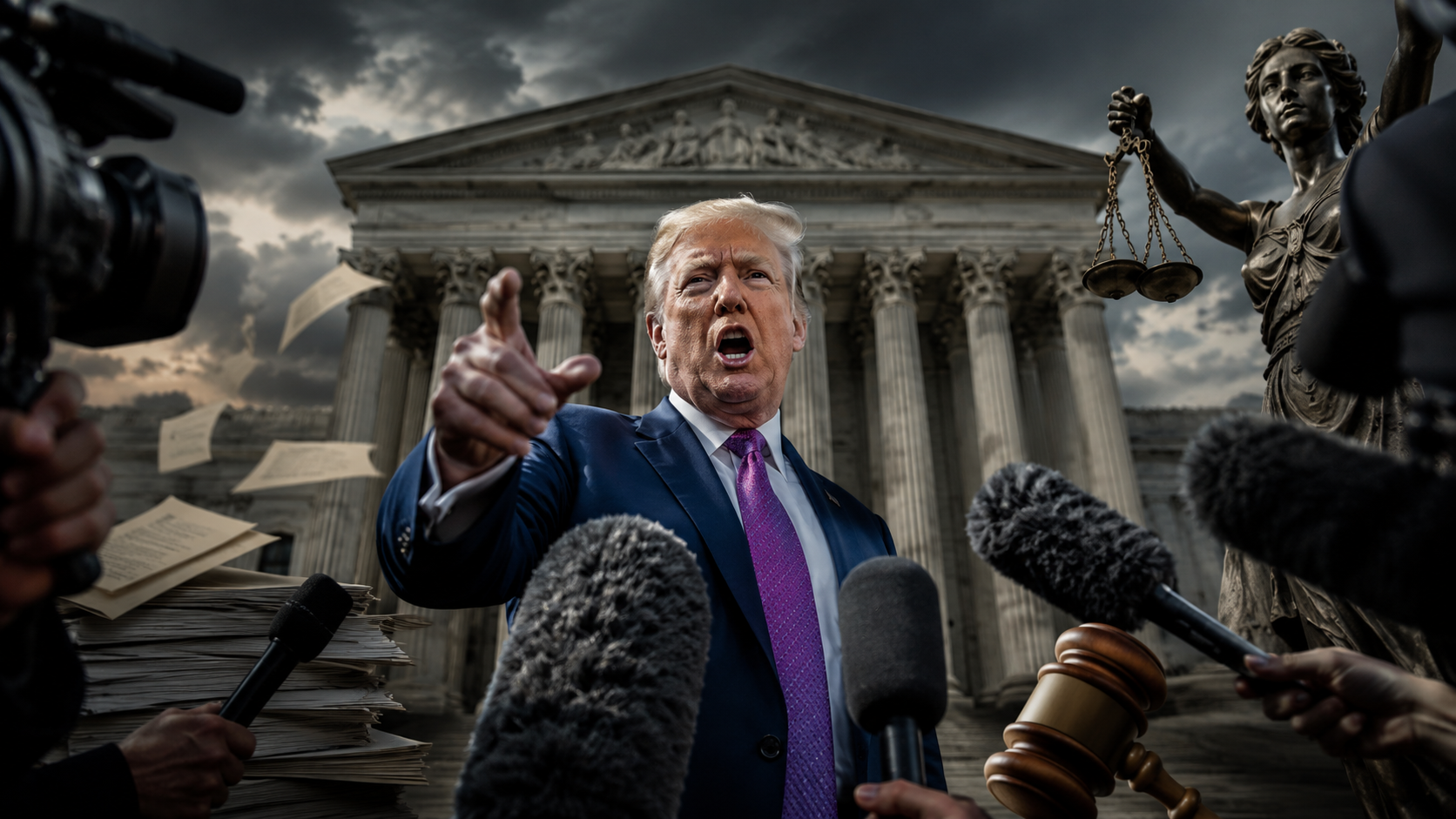
When Donald Trump filed a US$15 billion defamation lawsuit against The New York Times, Penguin Random House, and journalists connected to reporting and to the book Lucky Loser, the case could not be read simply as another legal dispute between a public figure and the press. The amount demanded immediately placed the lawsuit on a symbolic plane. But the most important element was not only the number. It was the political, communicational, and institutional function that a lawsuit of this type can perform inside a democracy under pressure.
Trump accused the newspaper, the publisher, and the authors of producing defamatory content about his financial history, business image, and the public construction of his reputation as a successful businessman. Shortly after the filing, a federal judge rejected the initial 85-page complaint, criticizing its form and requiring a shorter and more procedurally appropriate amended version. The court did not decide, at that stage, whether the reporting was true or false. What mattered was that the original complaint appeared excessive, rhetorical, and unsuitable as a clear legal pleading.
That procedural detail is politically revealing. In a democracy, legal form is not merely bureaucratic. It can function as a barrier against the transformation of courts into stages for political performance. Requiring a complaint to be clear, concise, and legally structured is also a way of preventing the judiciary from becoming a megaphone for political messaging.
The case illustrates one of the most sophisticated mechanisms of contemporary lawfare: the use of formally legitimate legal instruments to produce political effects that exceed the courtroom. Defamation law is legitimate in principle. Reputation matters. No one should be defenseless against false and damaging statements. But the problem begins when an instrument created to protect rights is used to intimidate the very activity that sustains democratic accountability: investigative journalism.
When a powerful public figure mobilizes the judicial system against journalists investigating matters of public interest, the central question is no longer only whether defamation occurred. Another question becomes unavoidable: what kind of political message does this lawsuit send to the broader information ecosystem?
The first dimension is legal. The right to reputation is real, necessary, and democratic. But democracy also depends on press freedom, public criticism, investigative reporting, and the possibility of examining the history of those who hold or seek power. The law cannot become a license to lie. But it also cannot become a reputational shield used to block public scrutiny.
Trump v. The New York Times sits precisely within that tension. The lawsuit appears as a claim for personal protection, but its size, context, targets, and political framing suggest a broader function: to turn the judicial arena into a battleground of narrative control.
The second dimension is communicational. This lawsuit does not exist only in court filings. It exists in headlines, social media posts, political speeches, press reactions, and public imagination. The lawsuit produces a narrative.
For Trump, it reinforces a familiar frame: major media institutions as hostile, partisan, corrupt, or illegitimate. For The New York Times, the case represents an attempt to intimidate independent reporting and discourage scrutiny. The dispute therefore operates as narrative warfare. Litigation becomes a way to shift the public question from "what did the reporting reveal?" to "why is the press attacking Trump?"
This inversion is central to media lawfare. The investigated actor seeks to occupy the position of victim. The watchdog becomes the aggressor. Investigation becomes persecution. Accountability becomes hostility. Journalism becomes enemy action.
The third dimension is economic and institutional. A US$15 billion claim is not merely a monetary demand. It is a signal of force. Even lawsuits unlikely to succeed can impose real costs: legal expenses, reputational pressure, editorial caution, psychological stress, institutional distraction, and intimidation of reporters and sources.
Large newspapers may resist such pressure. Smaller outlets, independent journalists, local newsrooms, and vulnerable sources may not. This is where the chilling effect becomes visible. Modern democratic censorship does not always appear as direct prohibition. Often it appears as risk calculation. An editor hesitates. A journalist softens a paragraph. A source withdraws. A publisher questions whether the story is worth the potential legal cost.
This is the logic commonly associated with SLAPP-style litigation: strategic lawsuits against public participation. The goal is not always to win on the merits. Sometimes the pressure is the point. The lawsuit becomes a warning to others: investigation may be legal, but it will not be free.
The first democratic paradox revealed by this case is the paradox of reputation. Democracy must protect individuals from falsehoods. But democracy must also prevent reputation from becoming a weapon against investigation. The more powerful the individual, the stronger the public interest in examining their record, contradictions, sources of wealth, and symbolic construction of authority.
The reporting and the book at the center of the dispute addressed one of the pillars of Trump's public persona: the mythology of self-made business success. The lawsuit, therefore, is not only a conflict over specific statements. It is part of a deeper struggle over who has the right to narrate the public biography of a political leader.
Does that narrative belong to the leader himself? To his campaign? To his lawyers? To the press? To documents? To public memory? The democratic answer cannot give narrative ownership to a single actor. The biography of power belongs to public debate.
The second paradox is formal equality before the law. In theory, everyone has the right to sue. A private citizen can file a defamation action, and so can a president or billionaire political figure. The form appears equal. But power is not equal.
A wealthy political actor with global visibility, a mobilized base, and constant media access does not use litigation in the same way as an ordinary citizen. The same legal instrument that protects a vulnerable person may become, in the hands of a powerful actor, a mechanism of systemic pressure. The form is symmetrical. The effect is not.
That is why democratic analysis cannot stop at the question: does he have the right to sue? Of course he does. The deeper question is: what power is being mobilized by this lawsuit, against whom, in what context, and with what consequences for the public sphere?
The third paradox concerns the judiciary itself. Courts exist to resolve conflicts through impartiality, procedure, and legal reasoning. But high-profile lawsuits can also pull courts into political spectacle. A complaint can become a speech. A hearing can become a campaign event. A procedural defeat can be converted into proof of persecution. A legal claim can become a media strategy.
In that sense, the judge's rejection of the first complaint can be read as a form of institutional resistance to performative litigation. Sometimes democracy is defended not through dramatic declarations, but through procedural discipline. A court protects its function when it refuses to let a legal pleading become a political manifesto.
Through the Lawfare4All analytical framework, the case concentrates several indicators.
There is persecution when journalists and authors are placed under direct legal pressure. There is disinformation when investigative reporting is reframed as illegitimate political hostility. There is game theory when the lawsuit sends a strategic signal to other media actors: scrutiny can carry a high cost. There is a neoliberal dimension when financial risk becomes a weapon against journalistic institutions. There is ideology when the press is constructed as an enemy of the people, the leader, or the nation. And there is sabotage when the practical environment necessary for democratic accountability is weakened.
But the case can also be summarized through three broader dimensions: it is legal in form, communicational in function, and economic-institutional in effect. That combination is precisely what makes it relevant to contemporary lawfare analysis.
The lawsuit does not operate in isolation. It connects legal procedure, political narrative, media confrontation, reputational control, economic intimidation, and democratic fatigue. It is not merely a defamation case. It is a message. And the message is clear: those who investigate power may be forced to pay a price.
The political cost is ambiguous. For Trump, the lawsuit may reinforce his image as a fighter against hostile media institutions. For supporters, it can function as proof of strength. For critics, it may appear as abuse. But for democracy, the deeper cost lies elsewhere: in the normalization of legal retaliation against journalism.
When billion-dollar lawsuits against reporters become ordinary tools of political struggle, the public sphere deteriorates. Democracy shifts from an arena of accountability into a field of intimidation.
The central point is not that every defamation action brought by a politician is lawfare. That would be too simplistic. The point is that certain lawsuits, in certain contexts, with certain targets, certain monetary demands, and certain accompanying narratives, may move beyond rights protection and become instruments of power.
Lawfare rarely announces itself as an exception. It appears through normal procedures, familiar legal language, and the formal architecture of rights. But its effects overflow the legal process and reach the democratic system itself.
Trump v. The New York Times shows how democracy can be pressured without being formally suspended. The press remains free, but intimidated. The courts remain open, but potentially instrumentalized. The right to reputation remains legitimate, but may be expanded into a threat against investigation. Criticism remains permitted, but surrounded by risks.
This is the democratic paradox in its contemporary form. Democracy is not eroded only by tanks, censorship offices, or classic coups. It can also be weakened through lawsuits, narratives of victimhood, economic threats, and campaigns to delegitimize institutions that produce public accountability.
The lawsuit does not need to win to matter. It matters when it frightens. It matters when it shifts the debate. It matters when it turns journalism into a minefield. It matters when it teaches other powerful actors that courts can be used as instruments of political communication. It matters when the most basic democratic question — what is power trying to hide? — begins to sound legally dangerous.
That is when defamation becomes a megaphone.
That is when reputation stops being only a legal category and becomes a strategy of narrative containment.
And that is when the democratic paradox appears with full force: an instrument created to protect rights can be used to intimidate those exercising another essential right; reputation can be invoked against accountability; and justice, if not alert, can be converted into a stage for a war against democratic scrutiny.
"The lawsuit does not need to win to matter. It matters when it frightens. It matters when it shifts the debate. It matters when it turns journalism into a minefield."
TrumpNew York TimesDefamationPress FreedomSLAPPMedia LawfareDemocratic ParadoxInvestigative JournalismLegal IntimidationLawfare4All